How does a heat pump work?
The science behind energy efficient home comfort
A heat pump is a low-carbon heating and cooling system that moves heat instead of generating it, using energy from the air, ground, or water to keep your home comfortable year-round. Factors like energy prices, home insulation, and available incentives all influence how well a heat pump can work for you. This article offers a complete step-by-step guide to how different heat pumps work: a deeper understanding of the technology, components, cost, installation and overall benefits.
What is a heat pump?
A heat pump is an electrically powered, low-carbon heating system that moves heat from the outside environment (air, ground, or water) into your home. Unlike traditional gas or oil boilers that generate heat by burning fuel, heat pumps use a refrigeration cycle to "amplify" existing ambient heat to a temperature suitable for heating and hot water or to run air conditioning units.
Research by the International Energy Agency shows that heat pumps can significantly reduce greenhouse gas emissions compared with gas boilers, with reductions of up to 80% depending on the electricity mix and system design¹. According to the European Heat Pump Association, switching from a gas boiler to a heat pump can reduce local air pollutants by up to 99%, as there is no on-site combustion.
Demand continues to grow across the UK. In 2025, around 125,000 heat pumps were sold², reflecting strong year-on-year growth as more households move towards efficient, lower carbon heating solutions.
Heat pump basics: Moving heat, not making it
The true genius of a heat pump lies in its ability to move heat, rather than having to make it. Whereas a gas boiler has to actually create heat by burning fossil fuels, a heat pump extracts existing thermal energy from the air, ground or water, and moves it from outside to inside - even when outdoor temperatures are low.
It works in much the same way as a refrigerator, except in reverse. While a fridge removes heat from inside its compartment and expels it into the kitchen (leaving the remaining cool air inside), a heat pump draws heat from outside and delivers it into the home.
Because the process uses existing heat, a heat pump is three to four times as efficient than systems that burn fuel. That means, for every 1kWh of electricity, you get 3-4 kWh of heat in return. You can learn more about heat pumps versus boilers here.
This efficiency translates into significant energy savings for homeowners, particularly in well-insulated properties, demonstrating why heat pumps are becoming the go-to technology for residential heating around the world.
The main components of a heat pump
Every residential heat pump consists of four essential components that make the heat transfer process possible.
- Refrigerant - the working fluid that powers the cycle
- Heat exchangers – the evaporator absorbs heat from the source, while the condenser releases heat into the home. These functions reverse when the heat pump is switched to provide cooling
- Compressor – increases pressure and temperature of the refrigerant and circulates it around the circuit
- Expansion valve – reduces pressure to restart the cycle and also regulates the flow of the refrigerant
Step by step: How a heat pump works
A heat pump operates in a continuous four-step cycle.
- Step 1: The refrigerant inside the evaporator absorbs heat from either the air, ground, or water - and vaporises
- Step 2: The compressor increases both the pressure and temperature of the refrigerant, thereby intensifying its energy content
- Step 3: This concentrated heat is transferred via the condenser to the building’s heating system or domestic hot water circuit
- Step 4: The expansion valve lowers the refrigerant’s pressure and temperature, so it’s ready to start the whole process again.
Some systems also provide cooling. In this case, the process is reversed.
Types of heat pumps: Air source, ground source, water source and hybrid
There are three main types of heat pumps, depending on where they extract their energy: air, ground, and water. There’s also a hybrid option, which combines a heat pump with a traditional boiler for a flexible, transitional solution.
Air source heat pumps
Air source heat pumps (ASHP) extract ambient thermal energy from the air outside - even in temperatures well below freezing - and turn it into efficient home heating. They can be air-to-air (connected to air conditioning units to heat or cool your home), or air-to-water (connected to radiators, underfloor heating etc), providing cost-effective year-round comfort, using minimal electricity.
ASHPs are the most common type of heat pump in residential settings as they are generally very easy to install, which can usually be installed without the need for any major structural work.
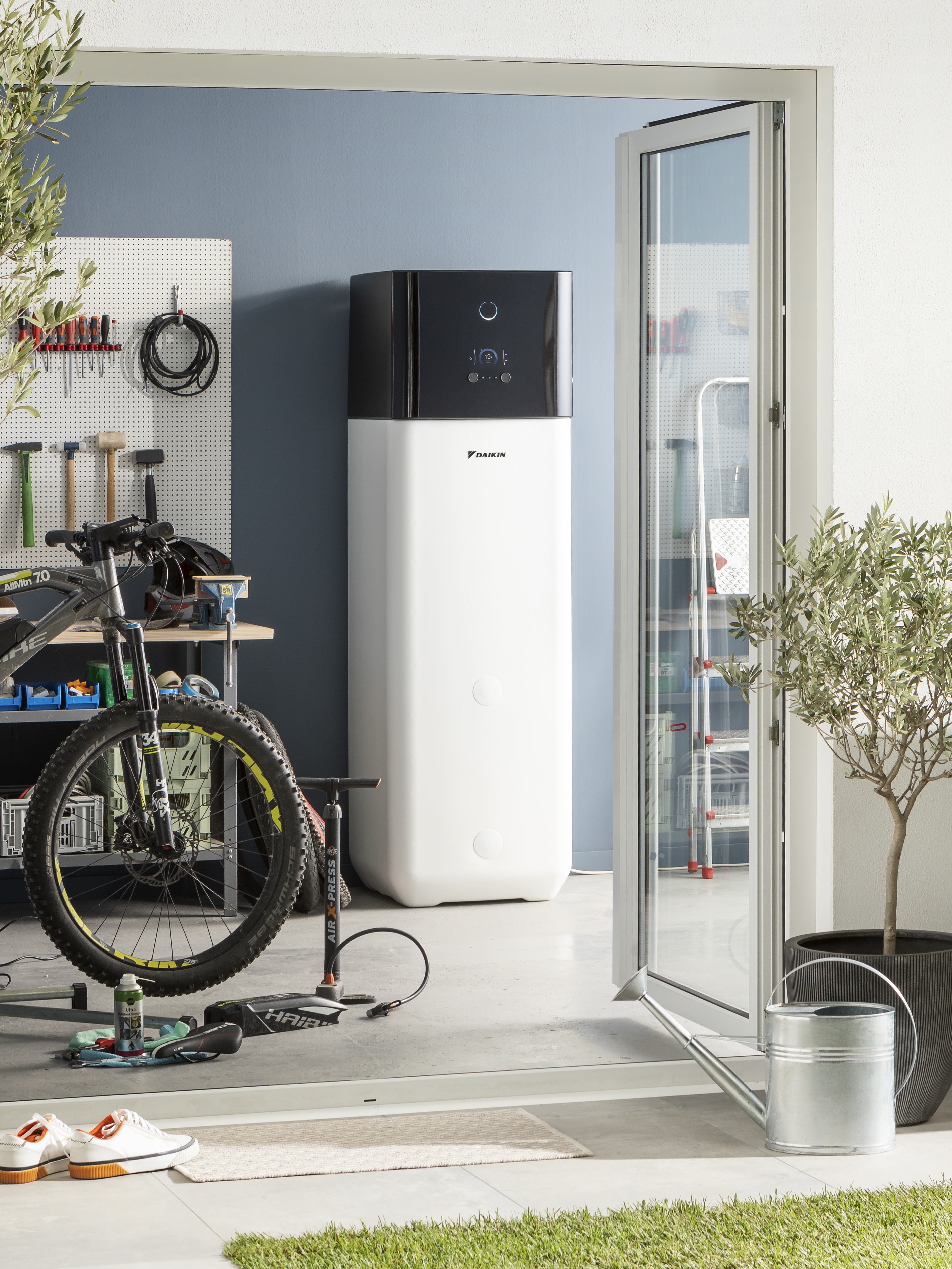
Daikin also offer an air-to-air system that also heats your domestic hot water tank. This does away with the usual need to heat your hot water using gas or electricity. No other air-to-air system currently available in the UK offers this option.
Ground source heat pumps
Ground source heat pumps (GSHP), often also referred to as geothermal heat pumps, tap into the more stable temperatures in the ground - typically around 0-10°C - to provide efficient residential heating and cooling. GHSPs can deliver remarkably stable performance all year round, with up to 400% efficiency in some cases.
GSHPs can cut heating costs by 40-60%, with equipment that often lasts more than 20 years. The main challenges with GSHPs are complexity and cost, as installation involves either trenching horizontal ground loops or drilling vertical boreholes.
However, for homeowners looking at the long-term, developers planning low-carbon homes, or areas with very cold winters where temperatures regularly drop to -30°C, investing in GSHPs pays off through lower operating costs, good reliability and more sustainable building practices.
Water source heat pumps
Water source heat pumps (WSHP) extract thermal energy from bodies of water such as lakes, ponds, or closed loop wells or water circuits to provide indoor heating and cooling.
Water source solutions are among the most efficient low carbon heating and cooling solutions available, especially when they are configured in self-contained, modular units, that can serve individual zones.
These systems deliver precise temperature controls and low seasonal operating costs, making them ideal for residential complexes or mixed-use buildings.
Hybrid heat pumps
Heat pumps can be connected to existing gas boilers, allowing homeowners to reduce their gas consumption without replacing their entire heating system.
In a hybrid set up, the heat pump efficiently handles most of the day-to-day heating, while the boiler kicks in during peak demand or extreme cold. Hybrid heating systems often use the gas boiler for domestic hot water, eliminating separate tank requirements.
The dual-source approach automatically optimises the system based on current conditions: heat pumps provide the heating when temperatures are milder or electricity is cheaper, while boilers provide reliable backup during harsh weather.
They’re great for areas where winters are moderate, or just for helping people to start reducing their reliance on fossil fuels.
Air-to-water versus air-to-air heat pump systems
There are two types of ASHP, air-to water and air-to-air:
Air-to-water heat pump | Air-to-air heat pump | |
| Primary function | Heats water for radiators, underfloor heating, and hot water tanks | Heats or cools air directly in living spaces |
| Heating type | Low-temperature, radiant heating | Instant air heating and cooling |
| Cooling capability | Usually requires separate system | Built-in cooling capability |
| Installation complexity | More complex due to plumbing | Easier and more compact |
| Integration with existing system | Needs existing radiators or underfloor heating | Can be installed in single or multi-zone setups |
| Space requirement | Larger, needs space for water tanks/piping | Compact, no tanks needed |
| Hot water supply | Standard feature | Optional, if manufacturer allows connection to domestic hot water tank |
| Best for | Homes needing comfortable, low-temperature heating | Homes needing quick, flexible heating and cooling |
How efficient are heat pumps? Understanding SCOP
The performance of heat pumps is measured using the Seasonal Coefficient of Performance (SCOP). This is a way of expressing the efficiency of a heat pump over an entire heating season and measures the total heat output against the electrical energy consumed – what comes out, versus what you have to put in.
For example, if 1kWh is electricity is used, and 4kWh of heat is generated, that would be a SCOP of 4, achieving an efficiency of 400%.
There are some simple steps that you can take to ensure your heat pump system is working as efficiently as possible. Read more in this article on five ways to optimise your air-to-air heat pump.
Heat pump efficiency vs gas boilers and electric heating
If you’re considering switching to a heat pump, it can be useful to understand how it would compare to your existing gas boiler or electric heating system from an energy performance point of view, and the SCOP measure can help you do that.
A Daikin heat pump, for example, is capable of converting 300%-400% of the energy put in, typically producing 3-4kWh of heat from 1kWh of electricity. This is a SCOP of 3-4.
While modern condensing gas boilers typically operate at much lower efficiencies, ranging from 99-109%. This is a SCOP of 0.99 - 1.09.
So it is clear that heat pumps are much more efficient than gas boilers.
Heating and cooling with one system
As we mentioned earlier, the beauty of a heat pump is that the process can be reversed in some systems to provide efficient cooling in the summer, so you don’t necessarily need a separate air conditioning unit.
It’s perfect for properties where both heating and cooling are needed throughout the year, and particularly as summer temperatures continue to rise. To minimise energy consumption, heat pumps can usually be easily connected to solar panels.
Refrigerants and safety in heat pumps
Refrigerants are the working fluids that enable the transfer of thermal energy as it changes between liquid and gas states. These specialised compounds circulate through heat exchanger coils, evaporating at low pressure to absorb heat, and condensing at high pressure to release it elsewhere.
Safety requirements vary depending on the type, so heat pump technicians should be certified and skilled in understanding proper handling procedures.
Heat pump grants and incentives
As the government work towards acheiving its net zero targets, a number of grant schemes and financial incentives have been introduced to help homeowners with the upfront cost of heat pump installation.
There are various funding options to help homeowners to reduce their carbon footprints.
Boiler Upgrade Scheme
The Boiler Upgrade Scheme (BUS) is a UK Government incentive covering England and Wales. The scheme supports both air-to-water (A2W) and air-to-air (A2A) heat pumps installed for space heating. Homeowners can receive £7,500 towards an air-to-water heat pump. A £2,500 grant for air-to-air heat pumps is expected to come into effect at some point during 2026.
Home Energy Scotland
The Home Energy Scotland Grant and Loan Scheme provides a grant of up to £7,500, an interest free loan of up to £7,500 or a combination of both to install heat pumps. An uplift of £1,500 is available for rural and island homes, meaning that they can claim up to £18,000.
It is alo worth noting that the government has removed VAT on air source heat pumps and air conditioning units until 31 March 2027. This could save you hundreds of pounds on the cost of installing your Daikin system. From 1 April 2027, a reduced rate of VAT at 5% will be applied.
Installation requirements of a heat pump
While the installation requirements of a heat pump depend on the type, here we’ll focus on air source heat pumps (ASHPs), as the most common system for residential homes.
- Noise: The outdoor unit of modern ASHPs operate at around 40-60 decibels, similar to a quiet conversation, but you’ll still need to think carefully about where to place it to minimise any visual and noise impact on your neighbours.
- Planning permissions: Planning regulations generally support the installation of heat pumps under permitted development rights, but you’ll need to check the exact rules around unit sizes and boundary distances with your local planning authority. Additional permissions may be needed for listed buildings and heritage sites.
- Indoor space: The indoor units are typically similar in size to a conventional boiler. You may also need a hot water cylinder for heating water.
- Insulation levels: A professional heat loss calculation will ensure your system is properly sized for your home and insulation levels – good insulation throughout helps to maximise the efficiency of your heat pump.
- Daikin installer: Daikin has a network of independent installers across the UK. To find your nearest one you can look at our Find an Installer pages.
Smart controls and zoning
Another benefit of heat pumps is that they can be integrated with smart home control systems, such as Hive and Google Home, so you can manage your home comfort level to suit your lifestyle.
You can create custom schedules, adjust settings remotely, heat different areas of the home independently, and monitor your energy consumption in real time.
Advanced systems will automatically adjust flow temperatures depending on weather conditions, maximising efficiency without you even having to think about it.
Discover more about Daikin’s smart control options and how they can simplify your daily comfort.
Maintenance and lifespan of a heat pump
Heat pumps typically last 15 to 20 years, while ground source systems can even reach 25 years, which is double the average lifespan of gas boilers.
Heat pumps are incredibly robust and therefore require minimal maintenance and repair. As with all heating systems, annual professional servicing is recommended, including essential tasks such as refrigerant level checks, coil cleaning, system calibration and filter cleaning, where applicable. These routine checks will help ensure the heat pump continues to operate at maximum efficiency for as long as possible.
Is your home suitable for a heat pump?
Heat pumps work well in a wide variety of property types, from new builds to historic renovations. The good news is that most properties in the UK are suitable for a heat pump.
New builds: When building a new house you have the flexibility of being able to design the optimum home comfort system, including any renewable energy products, such as heat pumps, solar PV, battery and EV charging.
Retrofit: Heat pumps can be retrospectively added to many types of property including detached, semi-detached, terraced homes and apartments.
Rural: Heat pumps provide a particularly good solution for rural properties without a gas connection, because it removes the reliance on oil and significantly reduces heating costs.
Learn more in our heat pump suitability guide for existing homes.
Heat pumps and carbon reduction
Of course one of the main reasons heat pump adoption is currently being encouraged is due to their significantly lower greenhouse gas emissions compared to fossil fuel heat sources.
The EU Joint Research Centre calculates that replacing one-third of Europe’s 86 million residential fossil fuel boilers with heat pumps could cut household final energy consumption by 36%, and CO₂ emissions by 28%.
Pairing with renewable energy sources
To really reduce your energy costs, and your reliance on fossil fuels, you could consider pairing your heat pump with other forms of renewable energy sources.
Adding solar PV and battery storage, for example, creates near zero-energy homes, while delivering unprecedented savings and energy independence.
European households with solar PV and heat pump combinations saved 62-84% on energy bills in 2022, with savings reaching €3,700 annually in Germany, Spain, and Italy.
Case study: A family home powered by a heat pump
The Schmidt family in Bavaria replaced their 15-year-old gas boiler with a Daikin air source heat pump system in 2023, achieving remarkable improvements in comfort and cost savings.
Their 150m² detached home, built in 1995 with recent insulation upgrades, previously consumed 18,000 kWh annually for heating, at a cost of €1,800. The €12,000 heat pump installation, reduced to €4,500 after German KfW incentives, now consumes only 6,000 kWh of electricity annually.
With their green energy tariff at €0.28/kWh, annual heating costs dropped to €1,680.
The family now benefits from consistent temperatures throughout the house, with the added bonus of summer cooling, eliminating the need for portable air conditioning units. Mrs Schmidt particularly appreciates the smartphone app control, allowing her to adjust the heating before she gets home from work.
Only minor thermostat upgrades were needed to integrate the system with their existing radiators and the whole install was completed in just two days.
Common heat pump questions answered
Heat pumps are often misunderstood, and a few common concerns still come up. Here are some of the questions we’re asked most often, with clear, straightforward answers:
Are heat pumps expensive to run?
Heat pumps are typically three to four times as efficient as a gas boiler, so they use less energy to deliver the same level of heating. This can help reduce energy bills over time.
You could save up to £378 per year compared with an oil boiler and up to £251 compared with a gas boiler. Over the lifetime of the system, this could mean savings of up to £3,000.
Upfront costs are also supported by government funding. In some cases, this can make installation comparable to, or even lower than, a standard boiler.
Are heat pumps noisy?
Heat pumps do make some noise, but they are much quieter than many people expect.
A typical outdoor unit operates at around 60 decibels, similar to a normal conversation or an electric toothbrush. Indoor units are quieter still, at around 30 decibels, comparable to a refrigerator.
Noise levels are also regulated. Heat pumps must meet strict sound limits and carry a CE label confirming their tested sound performance.
Do heat pumps work in cold weather?
Yes, heat pumps are designed to operate in cold conditions. Daikin heat pumps can continue to perform in temperatures as low as -25°C.
They work by extracting heat from the outside air, even when it feels cold. There is still usable heat energy present, which the system captures and upgrades to warm your home.
This allows heat pumps to provide reliable heating through radiators or underfloor systems, keeping homes comfortable throughout winter.
Key takeaways: how does a heat pump work?
Heat pumps are helping to define the future of home heating, delivering consistent comfort while significantly reducing carbon emissions and even energy costs. By transferring existing heat instead of generating it, they represent one of the smartest and most efficient ways to achieve a sustainable home. As technology advances and adoption grows, they are set to play an even more central role in creating climate-friendly, affordable homes for the future.
- Heat pumps provide efficient, low-carbon heating and cooling by moving heat rather than generating it.
- Multiple types—air, ground, water, and hybrid—offer flexible solutions for nearly any home.
- Heat pumps can cut household CO₂ emissions significantly, especially when paired with renewable energy.
- Heat pumps are shaping the future of sustainable home comfort.
Ready to find out more?
If you’re ready to take the next step and join the clean energy revolution, you can find out more about Daikin’s range of heat pumps on our website. We have solutions that are suitable for every property type.
If you want to find out what Daikin heat pump is best for you and how much it will cost, you can ask your local Daikin installer to contact you.